

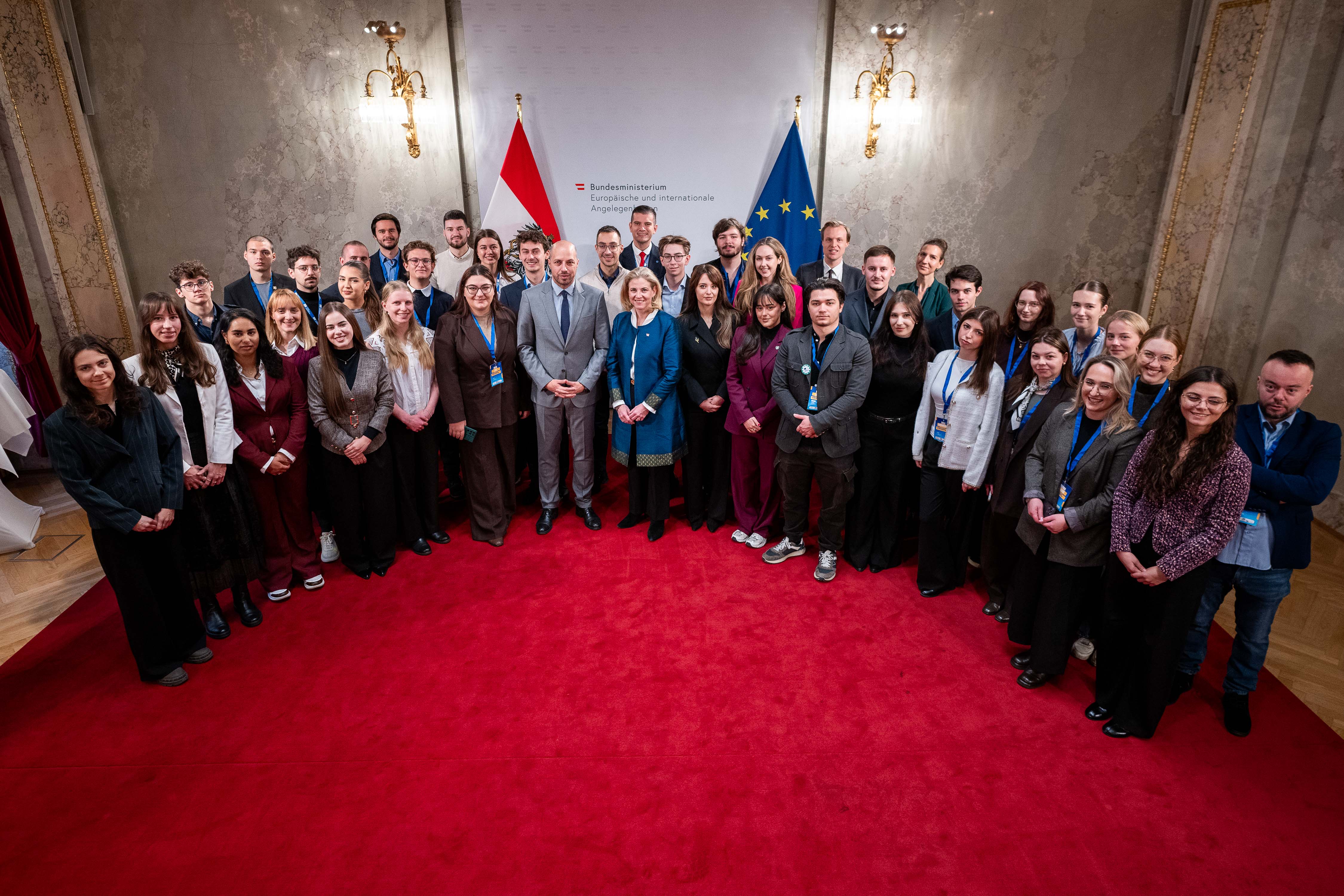
Vienna, 1-4 November 2026 – Young people from Austria and the Western Balkans Six gathered in Vienna for four days of dialogue, learning, and connection. “Experience Enlargement – The Youth Dialogue Austria and the Western Balkans” was a study visit built around intercultural understanding, regional cooperation, and the role of youth in shaping Europe’s future.
The initiative was implemented by the Regional Youth Cooperation Office (RYCO) in cooperation with the Austrian Federal Ministry for European and International Affairs and European Commission. It brought together participants from diverse backgrounds to engage directly with Austrian and European institutions, exchange views on European integration, and explore how young people can advance peace and reconciliation.
Beyond the formal sessions, the visit gave participants room to connect personally, question their own assumptions, and better understand their peers’ realities and aspirations. Many said they wanted to keep in touch after the visit.
During the visit, RYCO Secretary General Vladimir Obradović and Head of Programmes Marija Bulat held high-level meetings with Federal Minister Claudia Bauer, Bernd Brünner, Managing Director of the Austrian Development Agency, Kate Fearon, Director of the OSCE Conflict Prevention Centre, as well as representatives of the ERSTE Foundation, and the Austrian Federal Economic Chamber, reaffirming RYCO’s commitment to strengthening international partnerships.
Vladimir Obradović stated:
“We remain committed to European values and to empowering young people across the Western Balkans to connect, cooperate, and build a shared European future.”
Starting With Dialogue
The programme opened with introductory activities and cultural exchanges, giving participants a chance to get to know one another and share their expectations.
The official programme began at the Federal Ministry for European and International Affairs. Wolfgang Wagner, Head of Division for the Western Balkans, delivered a welcome address, followed by the session “Why the Western Balkans Matter to Austria.” It examined Austria’s relationship with the region and why continued cooperation matters for European integration.
In mixed groups, participants worked through a fictional scenario involving neighboring societies with unresolved historical tensions and differing views on reconciliation. They developed practical recommendations for building trust, ensuring meaningful youth participation, and creating opportunities for cooperation. The takeaway was that European integration is about institutions and policies, but also about the relationships people build. The workshop was delivered with the support of RYCO’s Head of Program, Marija Bulat.
In mixed groups, participants worked through a fictional scenario involving neighboring societies with unresolved historical tensions and differing views on reconciliation. They developed practical recommendations for building trust, ensuring meaningful youth participation, and creating opportunities for cooperation. The takeaway was that European integration is about institutions and policies, but also about the relationships people build.
Bringing Youth Perspectives Closer to Decision-Making
The study visit also offered direct contact with institutional representatives and a firsthand look at European and international policymaking.
At the Vienna International Centre, participants learned about the work of international organizations. They then met Ambassador Christian Ebner at the Permanent Representation of Austria to the United Nations.
A highlight was the youth dialogue with Beate Meinl-Reisinger, Austria’s Federal Minister for European and International Affairs, who discussed European integration and Austria’s relationship with the Western Balkans. The Secretary General of RYCO, Vladimir Obradovic also took part in the meeting with the Minister. The Minister encouraged participants to make the most of their time together:
“During your days in Vienna, I encourage you to make the most of being here together. Be curious. Ask difficult questions. Discuss about the future and less about the past. Share your experiences, challenge assumptions, and listen to perspectives that may be different from your own. You do not have to agree on everything. What matters is that you engage openly and learn from one another.”
The panel discussion “Our Vision for the WB6 2035,” facilitated by Anja Bebekovska, invited participants to look beyond current challenges toward the region’s long-term development and European future. The speakers were Vedran Džihić of the Austrian Institute for International Affairs; Anna Jankovic, former Director of the Cultural Forum in Belgrade and former Austrian Ambassador to Montenegro; and Larissa Lojic, an alumna of the College of Europe in Tirana who currently works at the BMEIA. The Secretary General of RYCO then handed out certificates of recognition for participant engagement and contribution over the four days.
Participants also met Patrick Lobis, Head of the European Commission Representation in Austria, and took part in an EU model simulation at Europe Experience Vienna. The exercise gave them a practical sense of European decision-making and the role of dialogue, negotiation, and cooperation.
On the final day, participants toured the Austrian Parliament and had a meeting with Members of the National Council of the Austrian Parliament, part of Bilateral Parliamentary Groups of the Western Balkans, chaired by Ms Alma Zadic. This tied the week’s discussions to institutional perspectives on regional cooperation and European integration.
Together, these activities showed participants how European institutions work and underscored the importance of youth voices in discussions about the region’s future.
Connections That Last
Some of the most meaningful outcomes came from the relationships participants built. Over four days, young people from Austria and the Western Balkans held open discussions, shared personal experiences, and found common ground despite different social, cultural, and political contexts.
Participants showed a strong willingness to understand one another’s perspectives. Austrian participants were curious about the Western Balkans, while those from the region were equally eager to learn from their Austrian peers and compare views on their shared European future. Conversations continued over shared meals, cultural activities, and informal gatherings.
By the end of the visit, participants said they wanted to stay connected and continue the exchange beyond Vienna. That enthusiasm points to the value of spaces where young people can build relationships based on mutual respect, curiosity, and shared aspirations.
Strengthening Regional Cooperation Through Youth Exchange
The Vienna study visit reaffirmed youth exchange as a practical tool for strengthening intercultural understanding, mutual trust, and cooperation between the Western Balkans and EU member states. Through institutional engagement, interactive workshops, and informal exchanges, participants reflected on their own role in building a more connected and cooperative Europe.
The programme also highlighted the importance of giving young people from the Western Balkans the chance to engage with their European peers on equal footing, in a dialogue that moves beyond political narratives toward shared experiences and aspirations.
For RYCO, the exchange reinforced the importance of bringing young people together as part of wider efforts to foster reconciliation, intercultural learning, and regional cooperation. Above all, it showed that a shared European future begins when young people have the chance to meet, listen to one another, and form connections that outlast any programme.
“Experience Enlargement – The Youth Dialogue Austria and the Western Balkans” is implemented in cooperation with the Austrian Federal Ministry for European and International Affairs, bringing together young people from the Western Balkans and Austria to promote dialogue, mutual understanding, and a shared European future.